
Communication Support · Carmel, Indiana
ABA Therapy for Non-Verbal Children in Carmel, IN
A child does not need spoken words to communicate. ABA therapy can help nonspeaking and minimally speaking children build a clearer, more reliable way to request, respond, make choices, and take part in everyday routines.

01 · Begin with the right assumption
Nonspeaking Does Not Mean Non-Communicating
Families often hear the term “non-verbal,” but many clinicians and advocates use “nonspeaking” or “minimally speaking” instead. A child who does not rely on spoken words may still communicate through gestures, facial expressions, movement, sounds, pictures, devices, and behavior.
That distinction changes the goal. Good ABA therapy should not begin with the assumption that speech must be forced. It should begin by identifying how the child already communicates and then making that communication easier to understand, easier to use, and more dependable across people and settings.
02 · More than one way to communicate
AAC, Pictures, Signs, and Devices Can Support Communication
Augmentative and alternative communication, often shortened to AAC, includes tools that supplement or replace speech when spoken language is not yet reliable. The best option depends on the child’s motor, learning, sensory, and communication profile.
Picture communication
A child may point to or exchange a picture to ask for an item, activity, person, help, or a break.
PECS
The Picture Exchange Communication System teaches a child to initiate communication by giving a picture to another person.
Speech-generating devices
A tablet or dedicated device can speak a selected word or phrase and give the child access to a larger vocabulary.
Signs and gestures
Simple signs, pointing, reaching, and other consistent gestures may be part of a practical communication system.
A common parent concern
Will a device or picture system stop my child from speaking?
Giving a child a reliable way to communicate does not mean the team has given up on speech. AAC can reduce the pressure and frustration around communication while spoken language continues to be modeled and supported when it is appropriate for the child.
03 · Functional Communication Training
Teach a Clearer Alternative to Communication Through Behavior
Behavior often communicates something. A child may grab an object, push materials away, cry, drop to the floor, or pull an adult toward a desired item because that is the most effective communication method currently available to them.
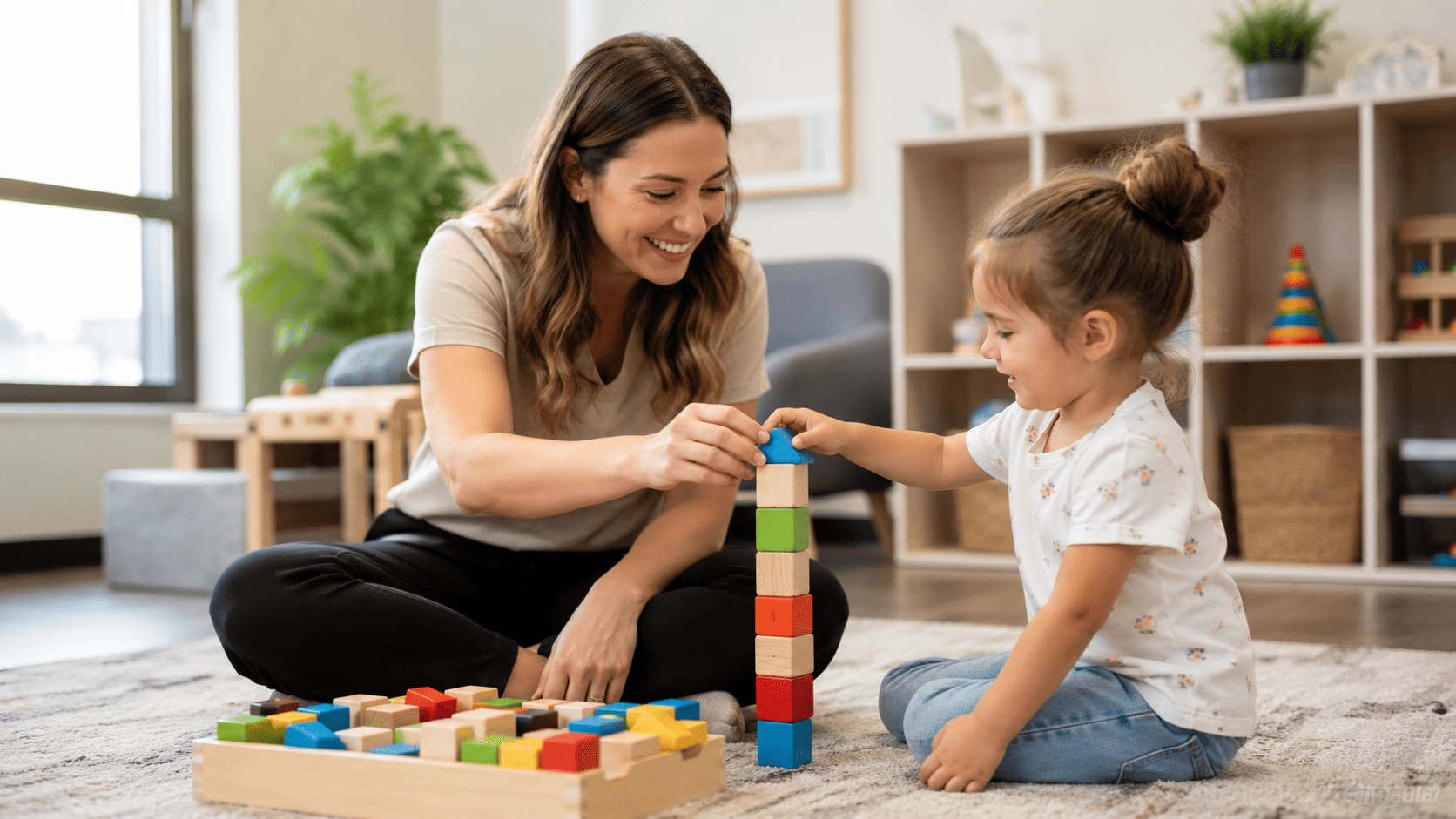
In Functional Communication Training, the BCBA first studies what the behavior may be communicating. The team then teaches a safer and clearer response that serves the same purpose, such as handing over a break card, pointing to a picture, selecting a word on a device, or using a consistent sign.
04 · Inside an ABA session
Visual Supports and Repeated Practice Make Communication More Predictable
Sessions for a nonspeaking child often include visual schedules, first-then boards, choice boards, modeled requests, preferred activities, and repeated opportunities to communicate. The technician may pause before giving a favorite toy so the child has a reason and an opportunity to request it.
Prompts should be reduced as the child learns. The purpose is not to make the child wait for an adult to tell them what to press or point to. The purpose is independent communication that works with different people, in different rooms, and during real family routines.
05 · One communication plan
ABA, Speech Therapy, and the IEP Team Should Reinforce the Same Skills
Communication goals can become confusing when a speech-language pathologist, BCBA, school team, and family each use a different vocabulary system or prompt the child in a different way. Coordination helps the child encounter the same words, symbols, expectations, and response methods across the week.
With appropriate family permission, ask how the ABA team communicates with the speech-language pathologist and the Carmel Clay Schools IEP team. The professionals do not have identical roles, but they should understand what the others are teaching and avoid creating disconnected communication plans.
“Which communication system will be available at home, in therapy, at school, and in the community?”
06 · Measuring meaningful progress
Progress Is Often a Series of Small, Trackable Changes
Communication progress does not always arrive as one dramatic breakthrough. It may begin with a child using one picture more consistently, requesting help before becoming overwhelmed, or using the same skill with a second caregiver for the first time.
Crying when an item is unavailable
The team identifies the likely request and teaches a picture, gesture, sign, or device response.
Uses the new response with a prompt
The child begins connecting the communication response with access, help, a break, or another outcome.
Initiates before frustration rises
Prompts decrease and the child starts communicating earlier and with less adult assistance.
Uses the skill with new people and places
The response becomes useful beyond one therapist, one table, or one therapy room.
07 · Before treatment begins
Questions to Ask an ABA Provider
How will you assess the ways my child already communicates?
Who selects or recommends the AAC system, and how is the speech-language pathologist involved?
How will you teach requesting, rejecting, asking for help, and asking for a break?
How will prompts be reduced so my child initiates communication independently?
How will the same communication system be practiced at home and school?
What data will show whether communication is becoming more useful and reliable?
Common questions
ABA Therapy for Nonspeaking Children
Communication goals should be individualized and coordinated with qualified professionals who know the child, including the BCBA and speech-language pathologist when applicable.
Can ABA therapy help a child who does not speak?
ABA can help teach functional communication through pictures, signs, gestures, speech-generating devices, spoken approximations, or a combination selected for the child.
Will AAC prevent my child from developing speech?
AAC gives the child a dependable way to communicate while speech and language development can continue to be supported. The communication system should be selected with the child’s needs and professional recommendations in mind.
What is Functional Communication Training?
Functional Communication Training identifies what a behavior may be communicating and teaches a clearer response that helps the child access the same need, such as help, a break, attention, or a preferred item.
Should ABA replace speech therapy?
No. ABA and speech-language therapy have different scopes. They can coordinate communication goals so the child receives consistent support rather than two unrelated plans.
How will I know whether communication is improving?
The team can track how often the child communicates, whether prompts are needed, which functions are expressed, how many people understand the response, and whether the skill transfers across settings.