


Brain Mapping for ADHD in Carmel, IN- See What's Really Happening

Families in Carmel are done guessing. MindWay ABA uses qEEG brain mapping to show exactly how your child’s brain is functioning, so ADHD support can be targeted, measurable, and built around real data, not assumptions.

Brain Mapping for ADHD, Carmel IN

Stop guessing what’s happening in your child’s brain. qEEG brain mapping lets us see it, and build a plan that actually fits.

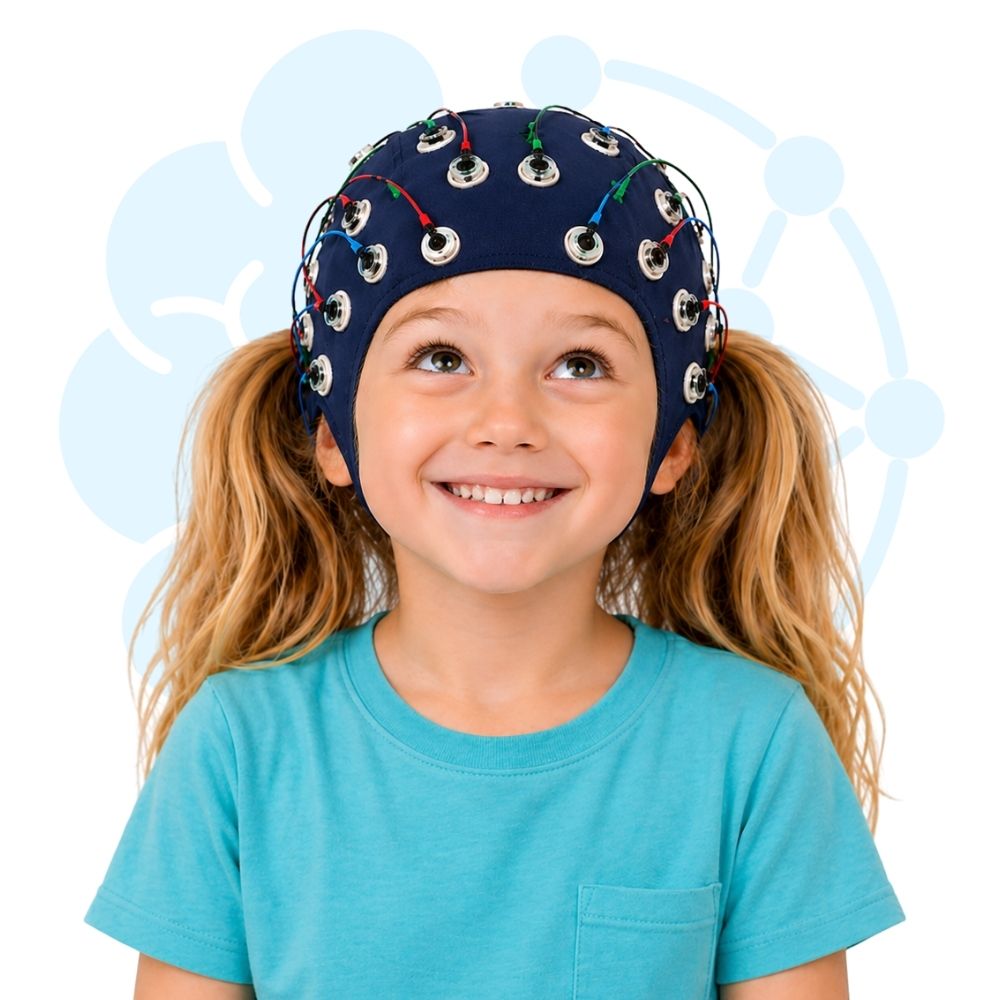
A young girl in a brain mapping cap being tested for ADHD in Carmel, IN.
WHAT IS BRAIN MAPPING

Seeing the ADHD Brain for What It Really Is

ADHD is a brain-based condition, not a discipline problem, and not a parenting failure. Yet most mental health services rely entirely on behavior checklists and observation, with no direct look at how the brain is actually functioning and why.

The same way we use qEEG brain mapping to understand autism, At MindWay ABA, we use qEEG (Quantitative Electroencephalography) brain mapping to measure your child’s brainwave activity in real time. Research shows that individuals with ADHD display measurable differences in brain electrical patterns, particularly elevated theta waves and reduced beta waves in the frontal lobe, the region responsible for attention and impulse control.[1]

Brain Wave Patterns in ADHD

qEEG maps these patterns across the scalp, revealing which brain regions need support.

Theta (4–8 Hz)

↑ Elevated in ADHD — linked to inattention

Beta (13–25 Hz)

↓ Reduced in ADHD — linked to focus & control

Beta brain mapping patterns in ADHD brains.

Alpha (9–12 Hz)

Monitored for regulation & relaxation

Alpha brain mapping patterns in ADHD brains.
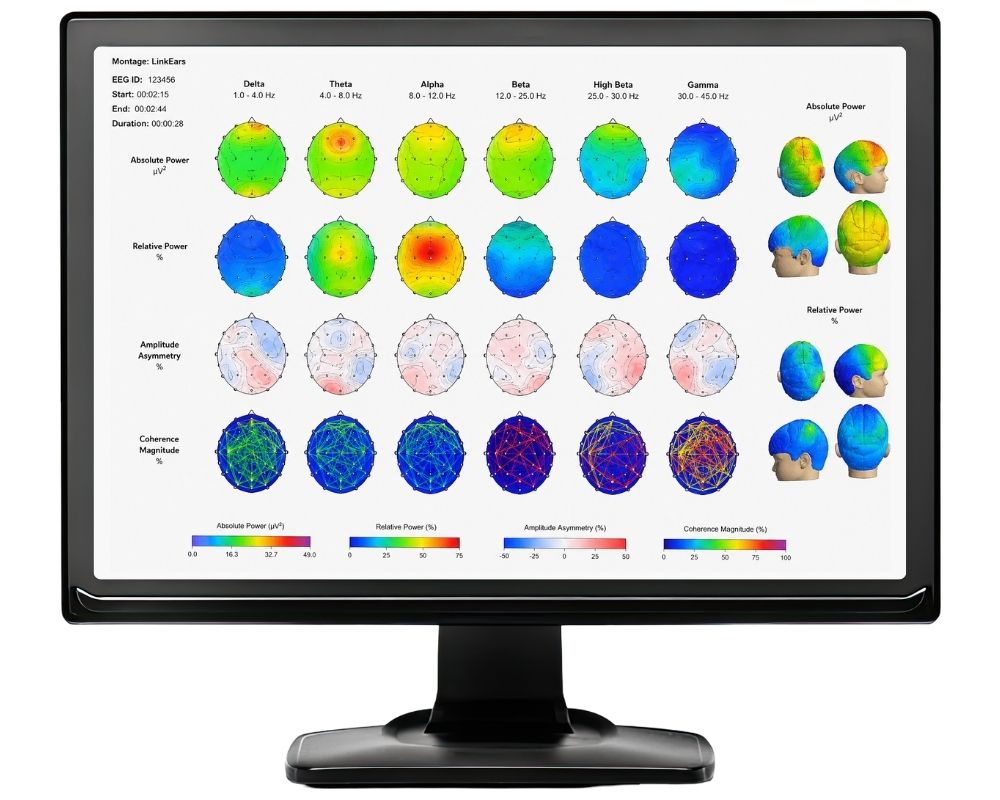
A sample brain mapping report for ADHD diagnosis.

ADHD looks different on every brain — and a map proves it

No two ADHD brains are identical. Some show excess slow-wave theta activity in the frontal lobe, the region responsible for attention and executive function. Others show under-activation in areas linked to impulse control. Some brains appear over-aroused; others, under-aroused. Without a map, every intervention is a guess.

MindWay ABA’s qEEG brain mapping session is non-invasive, painless, and takes under an hour. Your child simply wears a soft sensor cap while resting. The system records electrical signals and produces a color-coded report showing:

What qEEG Brain Mapping Shows

1. Brainwave activity by region

Delta, theta, alpha, and beta waves across frontal, temporal, parietal, and occipital lobes, mapped and compared to age-matched norms.

2. Focus, impulsivity, and memory markers

Specific measures including attention, aggression/impulsivity indicators, motivation patterns, and memory processing, visualized in a single readable report

3. A personalized ABA support plan

Your brain map findings directly inform your child's ABA therapy goals at MindWay, turning objective neurological data into a customized, targeted plan.

4. Progress benchmarks you can see

Follow-up maps show measurable changes over time — giving Carmel families and Carmel Clay Schools teachers a shared, evidence-based language for your child's progress.

WHY BRAIN MAPPING CHANGES EVERYTHING

What qEEG Reveals That Behavior Checklists Can't

Traditional ADHD evaluations rely on observation and self-report. Brain mapping adds a layer of objective neurological data, giving clinicians and families a far more complete picture.

01

Identify ADHD Subtype

ADHD is not one-size-fits-all. Research shows distinct brainwave patterns for inattentive, hyperactive, and combined types.[1] Brain mapping helps us identify which subtype your child has, so we can choose the most effective intervention, not just the most common one.

02

Pinpoint the “Why” Behind the Behavior

Is your child struggling to focus because of frontal lobe hypoactivation? Emotional dysregulation from overactive limbic circuits? Or anxiety masquerading as ADHD? A brain map helps us answer these questions with data instead of guesswork.

03

Track Progress Over Time

Unlike a behavior checklist, a brain map can be repeated. This lets us measure how your child’s neural activity changes in response to therapy, neurofeedback, or medication — giving you visible, data-backed proof that treatment is working.

04

Inform Medication Decisions

Dr. Yip comes from a background in neuropharmacology and recommends medication conservatively and only as a last resort. When medication is used, qEEG allows us to monitor how it affects the brain over time — not just behavior on a report card.

05

Separate ADHD from Comorbidities

Anxiety, sensory processing differences, and learning disabilities can look exactly like ADHD on a checklist. Brain mapping reveals distinct neurological signatures that help us understand what is truly driving your child’s challenges.

06

Guide Neurofeedback Protocols

Research published in NeuroImage: Clinical found that qEEG-informed neurofeedback achieved a 55% remission rate in individuals with ADHD.[2] At MindWay, brain maps allow us to assign individualized neurofeedback protocols rather than generic ones.

Parent Testimonials

Real Families. Real Progress. Real Hope

THE RESEARCH BEHIND OUR APPROACH

Grounded in Peer-Reviewed Science

PubMed · PMC Study

qEEG in ADHD Diagnosis & Subgroup Classification

A study published in Psychiatry Investigation reviewed quantitative EEG as a biological marker for ADHD diagnosis and subtype classification. Researchers found that distinct brainwave patterns, particularly in the theta/beta ratio (TBR) and phase-amplitude coupling, corresponded with specific ADHD subtypes. In a large-scale sample of 482 patients, sensitivity of 86% and specificity of 98% were reported for ADHD diagnosis using TBR measurements at the vertex electrode. The authors conclude that qEEG represents a promising objective tool for identifying neurophysiological differences across ADHD subtypes.[1]

Source [1] — PubMed / PMC8262972

Multicenter Clinical Trial · PMC

qEEG in ADHD Diagnosis & Subgroup Classification

A study published in Psychiatry Investigation reviewed quantitative EEG as a biological marker for ADHD diagnosis and subtype classification. Researchers found that distinct brainwave patterns — particularly in the theta/beta ratio (TBR) and phase-amplitude coupling — corresponded with specific ADHD subtypes. In a large-scale sample of 482 patients, sensitivity of 86% and specificity of 98% were reported for ADHD diagnosis using TBR measurements at the vertex electrode. The authors conclude that qEEG represents a promising objective tool for identifying neurophysiological differences across ADHD subtypes.[1]

Source [1] — PubMed / PMC8262972

Common Questions from Carmel Families

Frequently Asked Questions

No , a qEEG is a functional assessment, not a diagnostic tool on its own. It shows how your child’s brain is operating, which can complement a clinical ADHD evaluation and make treatment planning far more precise. MindWay ABA coordinates with your existing providers in Carmel and the greater Hamilton County area.

Absolutely. The demands of CHS’s block-eight schedule and AP coursework require strong executive function. Brain mapping helps identify specific regulation challenges — procrastination, emotional reactivity, difficulty initiating tasks — and creates a roadmap for meaningful support, whether your teen is 14 or 17.

School psychologists conduct behavioral and cognitive assessments which are valuable, but they don’t measure neurological activity. A brain map adds a layer of objective brain-based data that informs both your ABA therapy and can be shared with your child’s school team to support IEP and 504 planning.

Absolutely. The demands of CHS’s block-eight schedule and AP coursework require strong executive function. Brain mapping helps identify specific regulation challenges — procrastination, emotional reactivity, difficulty initiating tasks, and creates a roadmap for meaningful support, whether your teen is 14 or 17.


Coverage varies by plan. MindWay ABA’s team can help you navigate insurance questions. Many families in Hamilton County also use HSA funds for brain mapping services.
 
Autism Early intervention in Carmel, Indiana